Why switch to cargo bike?
Operational performance, competitive advantage, communication vector, environmental impacts,...
The reasons for those who would not go back
Operational performance
Bien au delà des seules considérations environnementales, le vélo cargo est un outil de performance opérationnelle tirant partie de ces capacités d'évolution agile et rapide en milieu urbain ou tout autre territoire contraint.
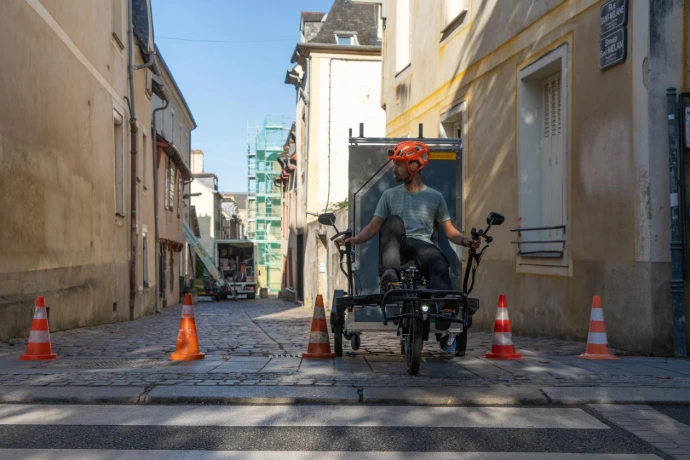
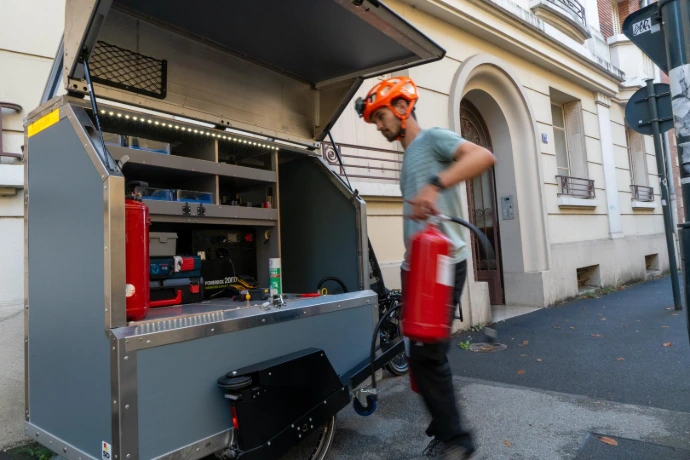
Without wanting to completely replace road vehicles, the cargo bike complements the range of solutions for diffuse flows and interventions where the ability to access as close as possible to delivery and intervention points is crucial.
Car contrairement aux idées reçues, le vélo cargo est souvent plus performant que l'utilitaire léger en centre-ville dense. Une étude majeure de l'Université de Westminster (2021) a démontré que les vélos cargos en zone urbaine sont 60 % plus rapides que les camionnettes. En ville, la vitesse maximale d'un véhicule n'a presque aucun impact sur son temps de trajet.
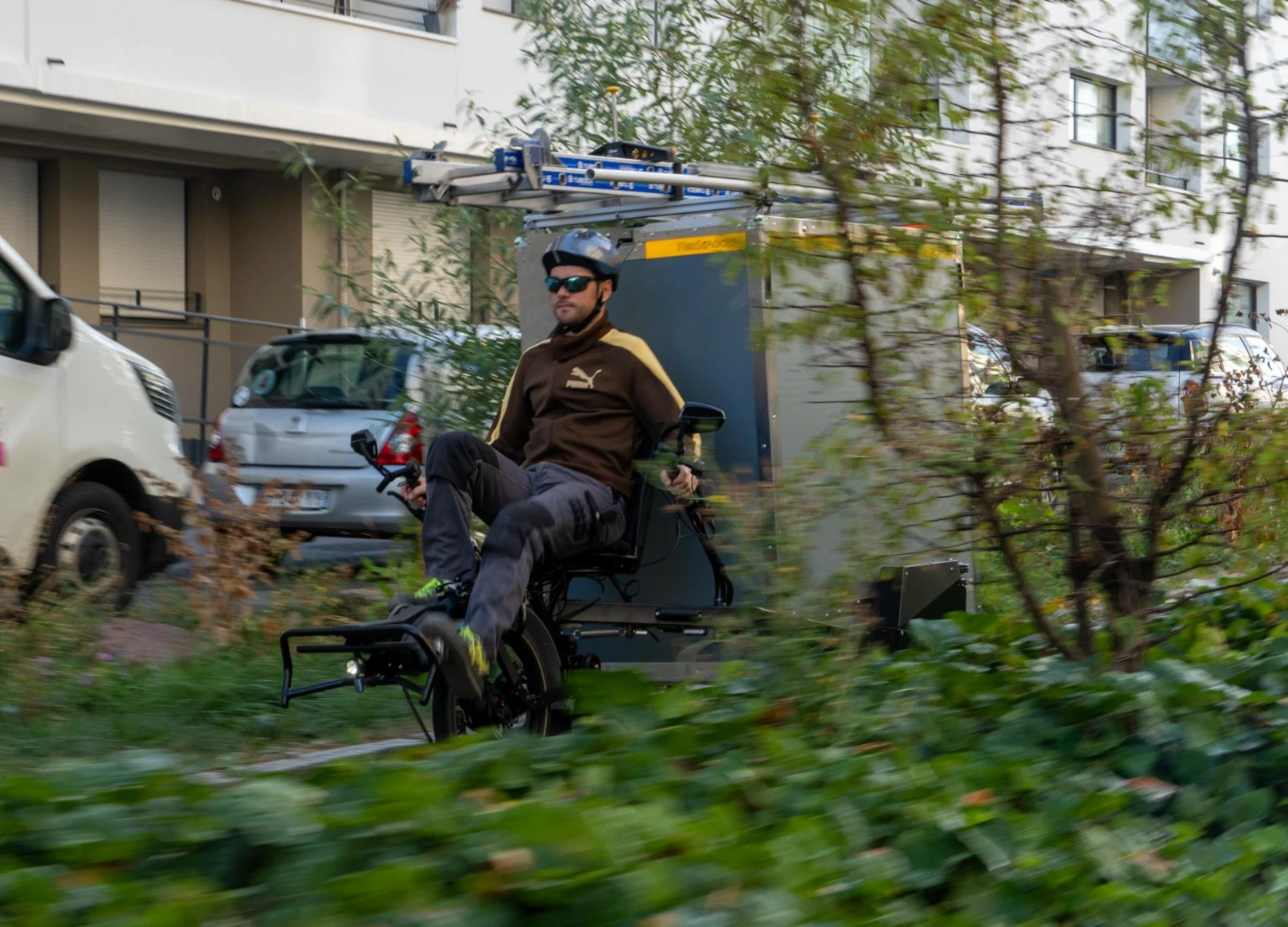
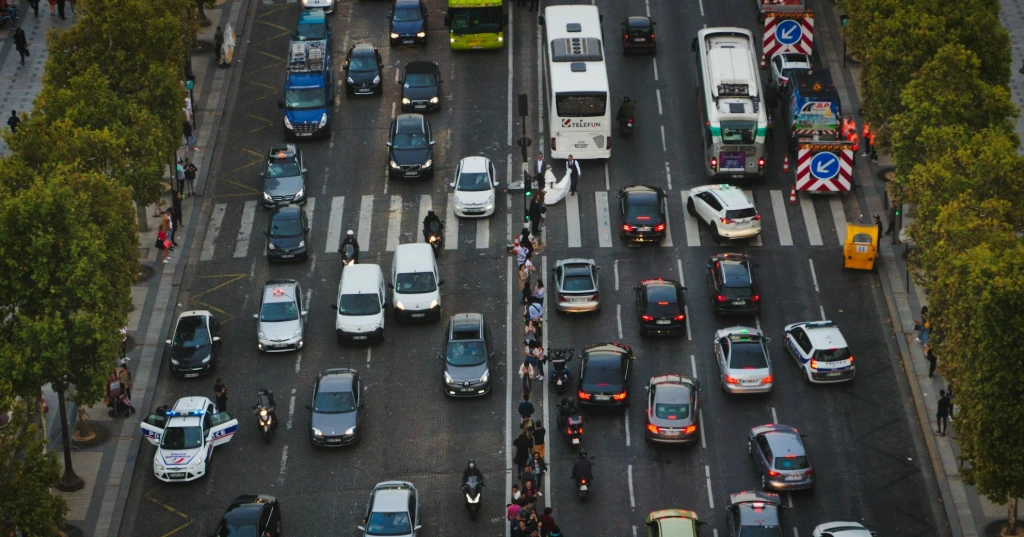
While a van is caught in traffic jams, the cargo bike uses cycling infrastructure and bypasses the many restricted traffic zones. Cargo bikes thus travel at a constant average speed, where vans spend 40% of their time immobilized in traffic or searching for a parking spot.
By being able to park as close as possible to these delivery or intervention points, the cargo bike professional saves valuable minutes at each stop and avoids having to park 200 meters away and finish the trip on foot with their load.
Reliability of travel times
In logistics as in service management, the enemy is not only slowness, it is uncertainty :
- In utility vehicles: The travel time for 5 km in the city can vary from 15 to 45 minutes depending on the time, an accident, or construction work. This "variance" forces the professional to take significant safety margins between two appointments.
- By cargo bike: Because it uses dedicated infrastructure and is unaffected by traffic jams, travel time is constant. If it takes 18 minutes to cross the city, it will take 18 minutes at 8:00 AM just as at 5:00 PM.
By mastering travel times, the professional can reduce these downtime periods and thus maximize their number of interventions. For illustration, an intervention at €80 more per day represents €1,600 in revenue per month.
Competitive advantage
While the use of electric vehicles addresses energy and climate challenges, and proves relevant for areas where traffic is not constrained, it conversely represents an illusion of transition for all constrained areas.
Electric or not, a utility vehicle will be equally constrained in traffic and its parking. The investment made in an electric vehicle, while it protects in the short term from the evolution of fossil fuel costs, does not generate productivity gains. At a time when low-emission zones are being abandoned, one can no longer rely on the regulatory advantage that could have been granted to electric vehicles: only operational efficiency will be differentiating.
By using cargo bikes, professionals align themselves with the trend of evolving city centers towards increasingly calm spaces where cycling is favored. It is rare to be able to gain such a competitive advantage.
Furthermore, the deployment of a fleet of electric vehicles creates needs for electric charging installations whose complexity and costs should not be overlooked. In contrast, a cargo bike only requires a simple 220V outlet to recharge its removable and manually interchangeable batteries.
Impactful communication lever
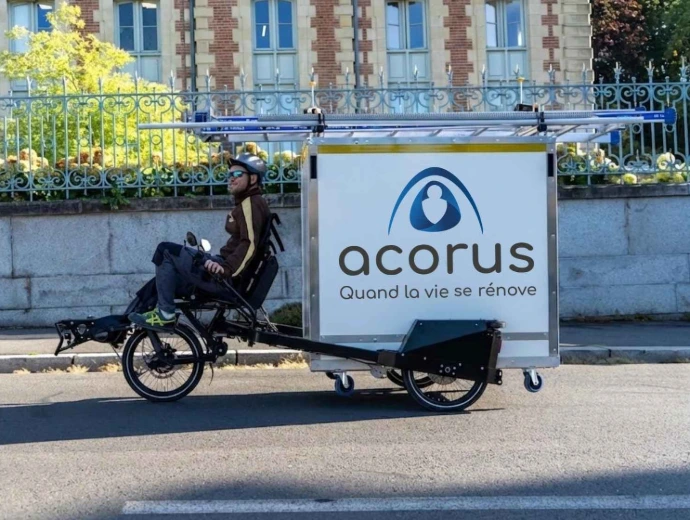
In an urban environment saturated with advertising and visual noise, the cargo bike is no longer just a transportation tool; it becomes an "identified advertising object." While white or gray vans blend into the mass and are often perceived as nuisances (congestion, noise), the cargo bike benefits from a premium for its atypical nature.
The human brain is programmed to ignore repetitive stimuli. A van, even branded, is processed by the brain as part of the urban decor. In contrast, the silhouette of the cargo bike is still unusual enough to catch the eye. And because it moves at a speed closer to that of pedestrians and often parks directly on the sidewalk near passersby, the reading time of the cargo bike is multiplied by 3 compared to a vehicle passing at 30 or 50 km/h.
By swapping the nuisance of bulky vans for an agile and silent presence, the cargo bike converts the annoyance of city dwellers into a immediate sympathy capital, positioning the professional as a dynamic and decidedly visionary actor of the city of tomorrow. In an era of widespread "Greenwashing," the cargo bike is a tangible proof of CSR commitments, much more powerful than an "eco-friendly" logo on a van.
Controlled environmental impacts
Adopting cargo bikes means committing to a radical decarbonization of one's activity: it emits up to 95% less CO2 than a conventional utility vehicle over its entire life cycle. Beyond the climate, it is an immediate public health lever, as it completely eliminates local emissions of NOx and fine particles, purifying the air in the neighborhoods it passes through.
Its material sobriety is exemplary: its construction requires 10 to 20 times fewer resources than that of a two-ton electric vehicle, with batteries that are infinitely less demanding in rare metals. By operating in near silence, it drastically reduces noise pollution, a major source of urban stress, thus improving the well-being of residents and employees.